

On a very practical level, AI is changing how everyday people interact with search engines which in turn is having a ripple effect on the online visibility of most businesses. SEO isn’t being replaced by AI, but the necessary SEO tactics are evolving.
Tools like Google’s AI Overviews, ChatGPT, and Perplexity don’t just rank pages like in years past. They synthesize answers, pulling from multiple trusted sources to deliver what they believe is the best possible response for a user. AI-powered search is changing how visibility in search results is earned. Here are some recent examples of how brands are showing up in generative search results on Google.
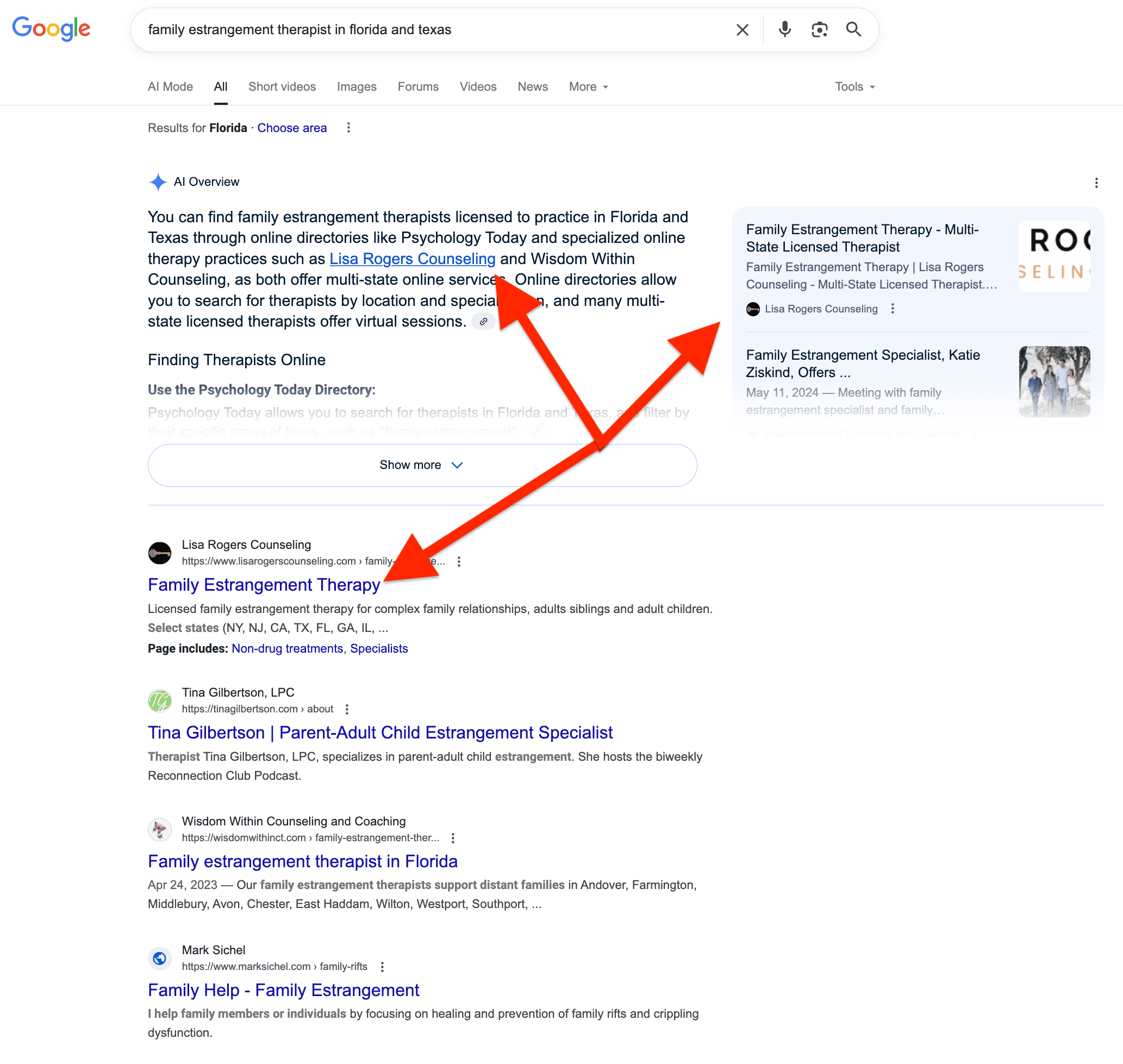
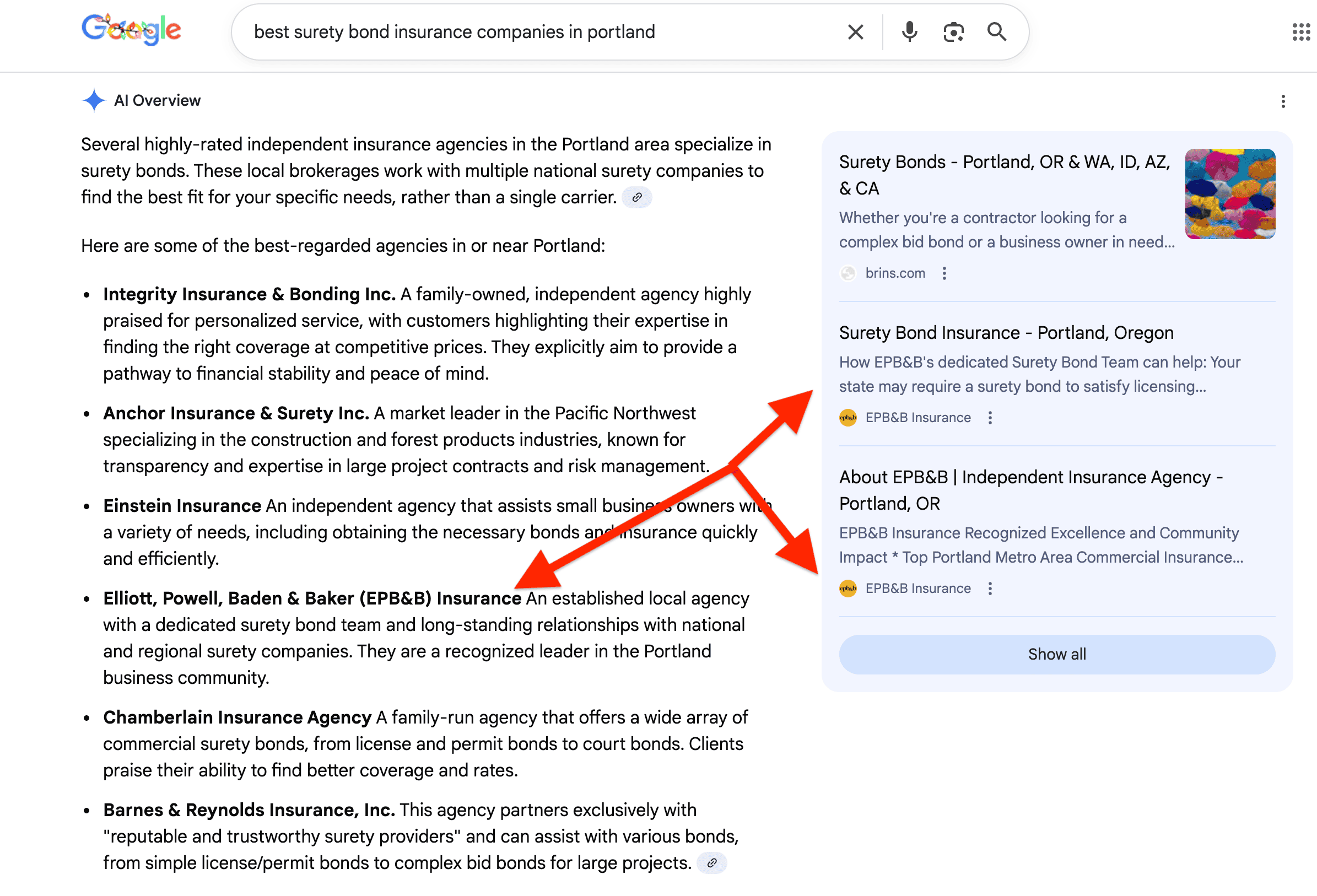
Displaying ranked pages is still part of search results, but it’s often not the primary focus of what is displayed. As a result, SEO (with the new AI influence) isn’t only about “ranking #1” anymore. It’s about being eligible, understandable, and trustworthy enough to be referenced in AI snippets.
We are finding that the brands that show up most often in AI-generated answers tend to share a common trait: they deliver an excellent user experience and send clear signals about who they are and what they know.
How AI Overviews and ChatGPT Actually Source Information
Understanding how AI tools pull information helps set realistic expectations.
Google AI Overviews
- Pull from multiple authoritative pages
- Favor clear, concise explanations
- Often blend content rather than quoting directly
- Heavily influenced by entity authority and topical depth
ChatGPT & Other AI Answer Engines
- Use a mix of:
- Licensed data
- Publicly available content
- Retrieval-based sources (depending on the tool)
- Prefer sources that are:
- Well-structured
- Factually consistent
- Clear about authorship and expertise
In both cases, AI is not looking for SEO tricks…it’s looking for content that reduces risk of misinformation and provides the best possible answer for the user.
Honestly, a lot of the same SEO strategy that we’ve used for the past 3-5 years is applicable today, however there are a few things we’ve added to the list to increase the likelihood of your business being surfaced in AI-driven search results. Below is the overall framework we use to help our clients brand show up in AI results in a way that drives new business and builds trust.
Technical SEO: Make Your Site Easy for AI to Access and Interpret
AI systems rely heavily on traditional crawl and index pipelines. If your site is difficult to access or structurally inconsistent, it’s far less likely to be used as a source.
No Indexing Issues
- Ensure important pages are crawlable and indexable
- Audit robots.txt for accidental blocking
- Validate XML sitemaps and remove non-indexable URLs
- Fix incorrect “noindex” tags
- Resolve 404s, server errors, and broken pages
- Use correct canonical tags
- Ensure only one version of your site is indexable (HTTPS, www vs non-www)
Clean Site Architecture
- Clear, intuitive navigation
- Important pages reachable within three clicks
- No orphan pages
- Logical internal linking with descriptive anchor text
- Clean category and pagination structures
Well Organized URL Structure & Security
- Short, readable URLs
- No duplicate URL variations (trailing slashes, capitalization, protocol issues)
- Valid SSL certificate
- HTTPS enforced site-wide
- Clean redirect logic with no chains or loops
Why this matters for AI:
Much like traditional SEO, AI systems prefer sites that reduce ambiguity. A technically clean site is easier for search bots to crawl, easier to understand, and easier to trust.
Content SEO: Be the Best Answer, Not Just Another Page
AI search heavily favors content that fully satisfies user intent. Thin or fragmented content rarely gets cited.
Content Quality & Intent Alignment
- Eliminate thin, outdated, or duplicate pages
- Avoid keyword cannibalization
- Match each page to a clear question or use case
- Write comprehensive, well-structured content
- Prioritize clarity, readability, and usefulness
Entity & Brand Clarity
- Clearly state who you are, what you do, and who you serve
- Maintain a strong About page with real company details
- Connect subdomains and brand properties clearly
- Use consistent naming across the site
Why this matters for AI:
AI systems evaluate topical completeness and confidence. Pages that clearly answer questions (without fluff) are more likely to be referenced.
On-Page SEO: Help AI Understand Meaning and Authority
On-page optimization helps bridge human understanding and machine interpretation. It gives context to the content.
Metadata & Structure
- Unique, descriptive meta titles and descriptions
- Clear heading hierarchy (H1–H3)
- Content that matches the promise of the title
Structured Data (Schema Markup)
- Validate schema using Google’s Rich Results Test
- Implement relevant schema types:
- Organization
- LocalBusiness (if applicable)
- WebSite
- WebPage
- FAQ or HowTo (when appropriate)
- Avoid conflicting or duplicated schema
- Include
sameAslinks to social profiles and related brand properties - Ensure schema accurately reflects visible content
Trust & E-E-A-T Signals
- Highlight experience and expertise
- Include author bios when relevant
- Show real team photos or facilities
- Link to active, legitimate social profiles
- Include required legal, medical, or financial disclaimers
Why this matters for AI:
Schema and trust signals help AI systems resolve who is speaking and why they’re credible. The goal is to help the search engines know that you’re an authoritative voice in your business niche….a key factor in citation decisions.
Off-Site SEO: Reinforce Trust Beyond Your Website
Although brand signals on third party websites are not a proven factor in AI search results (at this point), we can confidently say that consistent profiles and strong backlinks are a factor in overall SEO. In fact recently, posts from linkedin and Youtube videos have been showing up in generative search results.
Brand & Authority Signals
- Consistent NAP (name, address, phone) across directories
- Accurate and active social profiles
- Mentions on reputable third-party sites
- Alignment with Knowledge Graph data where applicable
Why this matters for AI:
Brands that appear consistent and legitimate across multiple sources are easier for AI to trust and reference.
What AI SEO Can’t Control (And Why That’s Important)
You Can’t Force Inclusion: AI visibility is probabilistic, not deterministic. You can improve eligibility and reduct ambiguity. You cannot guarantee citations or inclusion in generative search results
You Can’t Control Which Sources AI Chooses: AI systems may pull from competitors and use aggregated summaries. There are times were the AI tools favor larger or more established entities.
You Can’t Optimize for Every Prompt: Different users ask the same question in a myriad of different ways. AI responses change based on phrasing, context, location, and intent.
You Can’t Replace Authority Overnight: Trust is cumulative. It’s based on brand mentions, historical consistency and topical authority. These factors take time to build. The goal of AI SEO isn’t to game the system — it’s credibility in the public marketplace.
The Unifying Factor: User Experience Still Wins
When you step back, a clear pattern emerges: The sites most visible in AI search are usually the ones that already serve users exceptionally well. The sites with the most visibility typically have these characteristics:
- Easy to navigate
- Clear about who they are
- Technically sound
- Helpful and transparent
- Consistent across the web
AI systems are designed to reduce friction and uncertainty. If your site already does that for humans, you’re aligned with what AI search rewards.
Final SEO/AI Thought
Again, optimizing for AI search isn’t about gaming a new system. There are certainly some technical and on-page SEO tasks that will help, but at the end of the day it’s more holistic than that. It’s about building a brand and website that deserve to be referenced. Working through your site’s technical foundations, clear content, trust signals, and user experience won’t guarantee AI visibility, but they dramatically increase your chances as search continues to evolve.
Matt McComas is the lead SEO for Center Street Digital. He’s helped a lot of small business change the directory of their online visiblity. Need some help with SEO for your business? Reach out today.